A six-pack carrier looks like a simple folded box, but it is really a small structural product. It has to lift several pounds of beverage by a die-cut handle, hold that load while a shopper walks it to a car, and do it after sitting in a cooler where melting ice has soaked the board. The difference between a carrier that survives that trip and one that tears at the handle rarely comes down to the printing. It comes down to the paperboard: which grade it is, how thick it is, and how it behaves when wet. This is a look at those three variables and how to specify them without guessing or over-buying.
Start with the load the handle actually carries
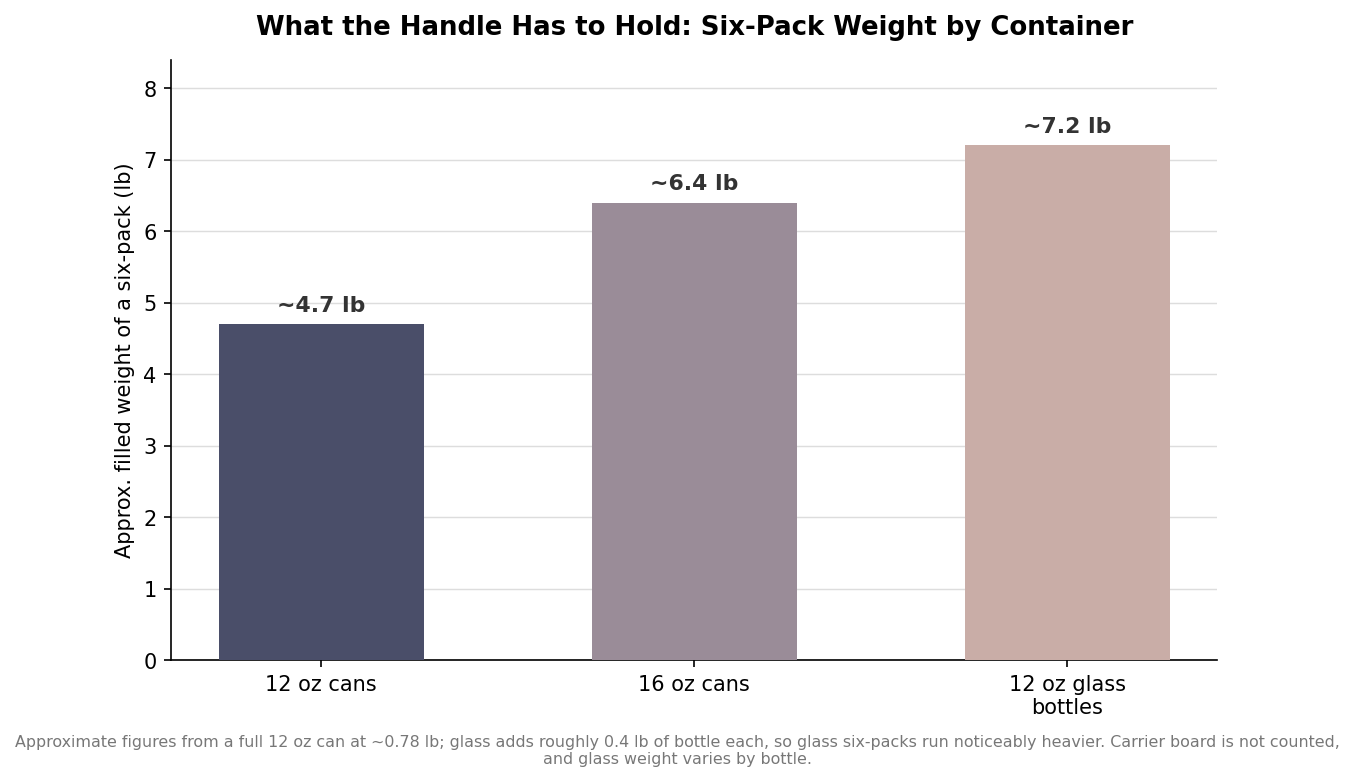
Before choosing a board you need to know what it has to hold. A full 12-ounce aluminum can weighs about 0.78 pounds, so a six-pack of cans runs somewhere near 4.7 pounds before you count the carrier itself. Move to 16-ounce cans and the same pack climbs to roughly 6.4 pounds. Glass is heavier still, because each bottle adds its own weight on top of the liquid, pushing a six-pack of 12-ounce longnecks to about 7 pounds. All of that hangs from a single handle, concentrated at the fold lines and the punch-out where a shopper’s fingers go. A board that feels perfectly sturdy flat on a desk can still fail at exactly that point, which is why the load, not the look, sets the starting spec.
The three board grades, and why beverages default to CUK
Folding-carton paperboard comes mainly in three grades, and they are not equally suited to this job. Coated unbleached kraft, or CUK, is made from virgin unbleached pulp with a brown interior, and it is the strongest of the common grades, with the highest tear resistance and wet strength. That combination is exactly what a loaded, condensation-soaked carrier needs, which is why CUK is the default choice for beverage multipacks and heavy-duty packaging generally. Solid bleached sulfate, or SBS, is virgin pulp that is white all the way through and prized for stiffness and a bright, premium print surface; it is the grade you reach for when the carton face has to look luxurious, but it carries a premium price and is chosen more for appearance and food contact than for raw wet strength. Coated recycled board, or CRB, uses recycled fiber with a white-coated face and a grey core. It is economical and fine for dry retail cartons like cereal, but its shorter fibers make it less stiff and prone to cracking on folds if the scoring is not perfect, which makes it a weaker candidate for a handle that has to bear weight while damp.
Caliper: reading board thickness in points
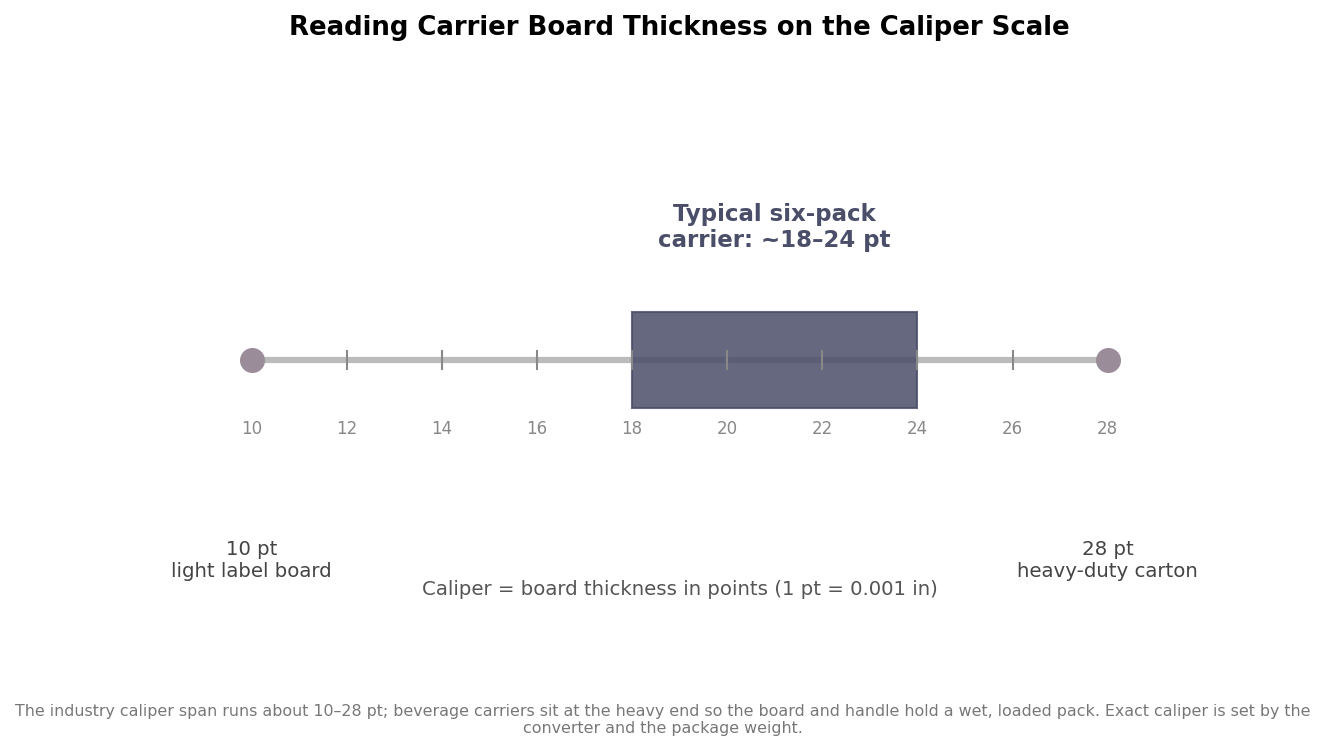
Grade tells you what the fiber is; caliper tells you how thick the sheet is. Caliper is measured in points, where one point equals one one-thousandth of an inch, so a 24-point board is 0.024 inches thick. Across folding cartons the range runs roughly from 10 points for light label board up to about 28 points for heavy-duty cartons. Beverage carriers live at the heavier end of that span, commonly in the neighborhood of 18 to 24 points, because thickness contributes directly to the stiffness and handle strength the pack demands. Going thicker buys you more rigidity and a stronger handle, but it also costs more per carton and interacts with folding: past a point, very heavy board wants clean, deep scores to fold without cracking. The right caliper is a balance the converter sets against the exact weight and geometry of your pack, not a number to maximize blindly.
The moisture problem, and why coatings matter
The reason wet strength keeps coming up is that a carrier’s hardest moment is usually a wet one. Ice in a cooler melts, cans sweat, and uncoated paperboard loses a large share of its strength as it absorbs water, softening right where the handle is under the most stress. Two things push back against that. The first is the grade itself, and CUK’s inherent wet strength is a real advantage here over recycled board. The second is the coating. A clear protective coat, whether an aqueous overprint or a heavier moisture-resistant treatment, slows water pickup and keeps the printed surface from scuffing as packs rub together in transit. If your product routinely lives on ice, that coating stops being a cosmetic upgrade and becomes part of the structural spec.
Specifying it without over-buying
Put together, the decision is a short chain. Start from the filled weight of your pack, cans are lighter, glass and larger formats are heavier, and let that set how much strength you need. Choose the grade against the job: CUK when the priority is holding weight and surviving moisture, SBS when a bright premium print surface justifies the cost, CRB only when the pack is light, dry, and price is the deciding factor. Then set caliper with your converter at the level that delivers the needed stiffness without paying for board you will not use. Whatever the combination, ask for a physical sample and, ideally, a loaded drop or carry test before committing to a full run, because a carrier is one of the few printed products where a spec that looks fine on paper can still fail in a shopper’s hand. The figures here are indicative and vary by converter and bottle, but the order of the questions, weight, then grade, then caliper, then coating, is what keeps a carrier from tearing at the worst possible moment.