Ordering custom six pack carriers for the first time raises a few practical questions before design ever comes up: how many do you have to order, what’s the board actually made of, and how long before they land at the brewery or the taproom. Those answers vary more between printers than most first-time buyers expect, and getting one wrong — committing to 10,000 units for a seasonal release, or specifying a board too light for 12 oz. glass — turns into a real cost problem later.
This guide walks through the numbers that actually matter when you request a quote: minimum order quantities, setup fees, board weights, and production timelines, pulled from working packaging suppliers so you have a benchmark before you talk to anyone.
None of this is theoretical. A brewery ordering its first run of custom six pack carriers is choosing between a $75 setup fee and a 150-unit minimum from one supplier, or a 10,000-unit minimum from another built for high-volume national brands — and those two paths lead to very different budgets and timelines.
Source: Pak-it Products, custom printed 6-pack cardboard carrier product page (pakitproducts.com), 2026
What custom six pack carriers are actually made of
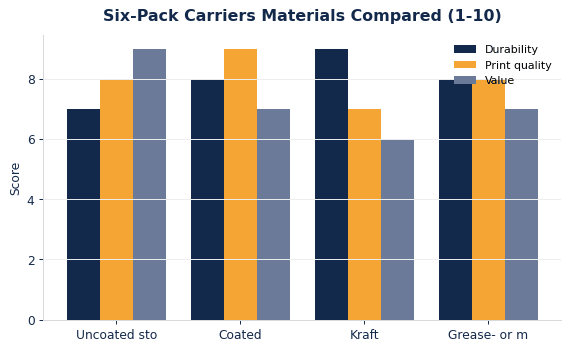
Most custom six pack carriers are cut from one of three stocks, and the right one depends on what’s going inside it. White SBS (solid bleached sulfate) paperboard is the standard choice for full-color branding — it takes offset and digital print cleanly and is typically offered in 14pt, 16pt, 18pt, or 24pt calipers, with the heavier weights holding up better to condensation and repeated handling. Kraft paperboard runs in similar calipers but stays uncoated and unbleached, which is why it shows up so often on carriers going for a natural, sustainable look rather than a glossy finish.
For heavier glass bottles, corrugated board is the more common structural choice. Corrugated carriers are typically specified in the 32 to 48 ECT range (a measure of the flute’s crush resistance), and that extra rigidity matters once you’re carrying six 12 oz. or 16 oz. glass bottles by a single handle cutout. Lighter cans generally don’t need that much board — a mid-weight SBS or kraft carrier holds a can six-pack fine and costs less per unit.
| Material | Typical Caliper / Strength | Best Suited For |
|---|---|---|
| White SBS paperboard | 14pt–24pt | Full-color branding, cans and lighter bottles |
| Kraft paperboard | 14pt–24pt, uncoated | Natural/eco branding, cans and lighter bottles |
| Corrugated (flute) board | 32–48 ECT | Heavier 12–16 oz. glass bottles, rough handling |
Cans vs. bottles change the math
A can carrier and a bottle carrier aren’t interchangeable even at the same six-pack count. Cans are lighter and uniform in shape, so a mid-weight paperboard carrier with a simple die-cut handle usually does the job. Bottles — especially 12 oz. and 16 oz. glass — put more shear stress on the handle cutout and the dividers between bottles, which is why suppliers push heavier corrugated stock or reinforced handle cutouts for glass. If you’re ordering for both formats, expect two different specs, not one carrier that does both.
How much custom six pack carriers actually cost
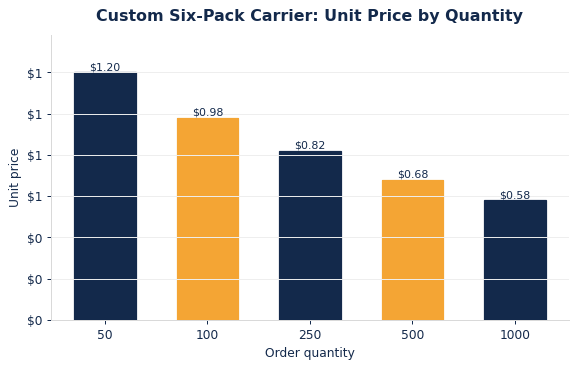
Pricing on custom six pack carriers is driven by three things: quantity, number of print colors, and whether you’re printing one side or two. As a floor reference, an unprinted stock kraft carrier — no custom art, just plain board — runs about $0.81 to $0.88 per unit when bought at 135 per case, priced around $108.99 to $119.00 per case. That’s useful as a baseline: any custom-printed quote you get should be weighed against what blank stock costs before setup and print charges are added.
On the custom side, one supplier’s published pricing structure requires a minimum order of 150 carriers and charges a $75 setup fee per screen, per color — so a two-color design adds $150 in one-time setup on top of the per-unit price. Repeat orders using artwork already on file typically skip that fee entirely, which matters if you’re reordering the same design seasonally. Other suppliers serving larger brands set minimums as high as 10,000 units, with correspondingly lower per-unit costs once you’re in that volume — those quotes make sense for an established brand doing a national run, not a first order from a new taproom.
Two-sided printing is worth asking about specifically: several suppliers charge extra for it, and it’s an easy line item to miss when you’re comparing quotes side by side.
Lead times: how long custom six pack carriers take
Once artwork is approved, standard production on smaller custom runs is around three weeks before the carriers ship. That number comes from a supplier working at the 150-unit MOQ tier — larger custom runs, more complex dielines, or suppliers running big-brand volume can extend that considerably, so don’t assume every quote implies the same timeline.
Build in time before that three-week clock even starts. Artwork approval itself can take a round or two of proofing, especially if you’re matching a specific Pantone color for a brand logo. If you have a launch date — a festival, a distribution deadline, a seasonal release — work backward from it: proofing, then production, then shipping, then whatever buffer you want before the actual event.
Print and finish options
Full-color offset and digital printing are both common on custom six pack carriers, and most suppliers also offer finish upgrades: matte or gloss lamination, spot UV for highlighting a logo, and foil stamping for a premium look on a limited release. Each finish option is typically a separate line item, so it’s worth deciding early which ones actually matter for your shelf presence versus which ones just add cost without changing how the carrier reads on a store shelf or bar top.
Screen printing vs. full-color digital
Screen printing (the process behind that per-color, per-screen setup fee) is common at lower volumes and works well for one- or two-color designs — logo plus one accent color, for example. Once you’re running a full-color photographic design or a design that changes by SKU, digital or offset printing tends to be the more practical route, since it doesn’t add a new setup charge for every additional color.
Ordering checklist before you request a quote
Before you contact a supplier, know your bottle or can format (12 oz., 16 oz., cans vs. glass), your target quantity, and roughly how many print colors your design uses — those three answers determine most of the quote. Ask directly whether the price includes setup fees, whether two-sided printing costs extra, and whether reorders on the same artwork waive the setup charge next time.
Also confirm the board spec in writing — caliper for paperboard, ECT rating for corrugated — rather than trusting a general description like “heavy duty.” A carrier rated for 12 oz. cans won’t necessarily hold six 16 oz. glass bottles without failing at the handle, and that’s not the kind of thing you want to discover after the carriers ship to a distributor.
Frequently asked questions
What’s the minimum order quantity for custom six pack carriers?
It depends heavily on the supplier. Smaller-run printers can start as low as 150 units, while suppliers set up for national-brand volume may require minimums of 10,000 units or more. If you’re a new brewery or brand placing a first order, look specifically for suppliers advertising low minimums rather than assuming you’ll need to buy in bulk.
How long does it take to get custom six pack carriers made?
On a smaller run, standard production is roughly three weeks after your artwork is approved — not from when you place the order. Factor in extra time for proofing and color matching before that clock starts, and expect longer timelines on large or highly customized runs.
What material should I use for glass bottles versus cans?
Heavier corrugated board, typically in the 32–48 ECT range, holds up better under the weight and shear stress of glass bottles, especially 12 oz. and 16 oz. formats. Cans are lighter and more uniform, so a mid-weight SBS or kraft paperboard carrier — commonly 14pt to 24pt — is usually sufficient and less expensive.
Do custom six pack carriers cost more to print on both sides?
Often, yes. Several suppliers charge an additional fee for two-sided printing on top of the base per-unit price, so it’s worth asking about explicitly when comparing quotes rather than assuming it’s included.
Are there setup fees for custom printing?
Most screen-printed carriers carry a per-color, per-screen setup fee — commonly around $75 per color on smaller runs — charged once for a new design. Reordering the same artwork later typically skips that fee since the supplier already has your plates or files on hand.
Is kraft or paperboard more eco-friendly?
Uncoated kraft paperboard is generally viewed as the more sustainable-looking option since it skips bleaching and coating, and it’s commonly recyclable and compostable depending on any inks or finishes used. Coated white SBS paperboard can still be recyclable, but check with your supplier on the specific coating and finish before making sustainability claims to customers.
The bottom line
The fastest way to avoid a bad first order is to get three or four quotes and compare them on the same terms: total price per unit at your target quantity, setup fees, whether two-sided printing is included, and a written material spec. Custom six pack carriers aren’t a commodity item with one standard price — the gap between a 150-unit minimum and a 10,000-unit minimum, or between kraft paperboard and corrugated, is wide enough to change your budget by an order of magnitude. Know your volume and your bottle or can format going in, and the rest of the quote conversation moves a lot faster.